What Is Agentic AI? A Complete Guide for Business Leaders

Introduction
Artificial intelligence is moving beyond systems that simply answer questions, generate content, or summarize information.
The next shift is toward AI systems that can understand a business goal, plan a sequence of actions, use tools and business systems, make decisions within defined boundaries, and involve humans when judgment is required.
This is the idea behind agentic AI.
For business leaders, the important question is not simply, “What can an AI agent do?” The more useful question is:
Which business processes can an AI agent execute from beginning to end, and where should humans remain in control?
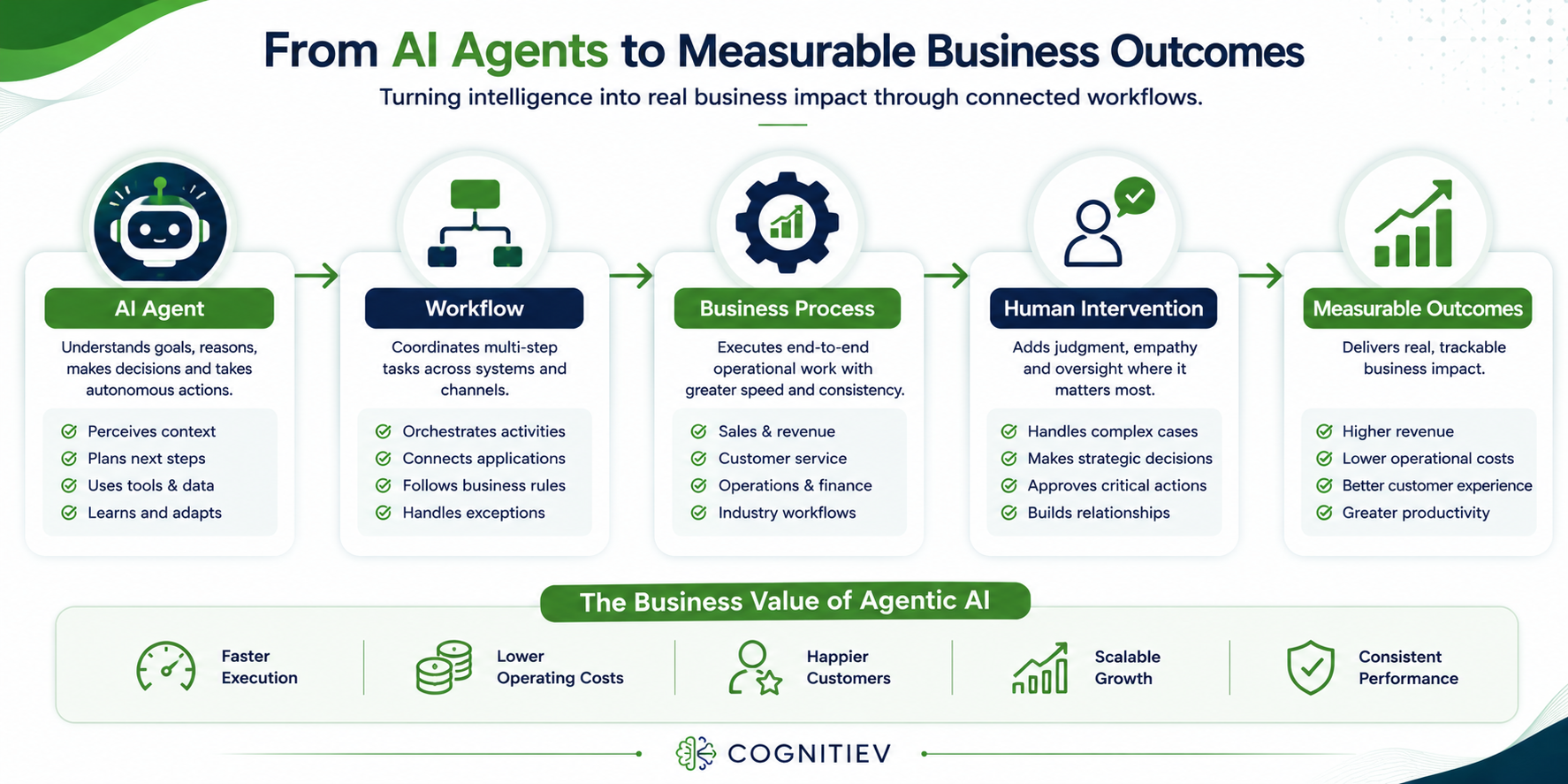
That distinction matters because an AI agent by itself is only one component. The real business value appears when agents are connected to workflows, workflows are embedded into business processes, and those processes produce measurable outcomes.
IBM describes agentic AI as systems capable of accomplishing goals with limited supervision. McKinsey similarly describes AI agents as software components that act on behalf of users or systems and coordinate complex workflows.
The agentic operating model
AI agent → workflow → business process → human intervention → measurable outcome
This guide explains what agentic AI means, how it works, how it differs from generative AI, where businesses can use it, what risks leaders should consider, and how to implement it using the Cognitiev 7-Stage Agentic AI Framework.
What Is Agentic AI?
Agentic AI is a type of artificial intelligence that can pursue a defined goal by planning tasks, making decisions, using tools and business systems, taking actions, and adapting to changing conditions with limited human supervision.
Unlike a traditional chatbot that waits for a prompt and produces a response, an AI agent can be given an objective and determine the steps required to accomplish it.
For example, instead of asking an AI to “Write a follow-up email to this lead,” a business could instruct an agent:
“Follow up with qualified leads who have not responded in seven days, determine their current interest, answer basic questions, schedule meetings when appropriate, update the CRM, and escalate high-value opportunities to a sales representative.”
The second scenario is closer to agentic AI because the system participates in executing a business process, not simply generating content. IBM notes that agents can break complex problems into smaller tasks and use tools, APIs, knowledge stores, and enterprise applications to complete objectives.
Agentic AI Meaning: What Does “Agentic” Actually Mean?
The word agentic comes from the concept of agency: the ability to act purposefully.
In business AI, agentic behavior generally means an AI system can:
- Understand a goal.
- Assess available information.
- Create or select a plan.
- Decide which tools are required.
- Execute actions.
- Evaluate the results.
- Continue, adjust, or escalate when necessary.
This is fundamentally different from treating an LLM as a question-and-answer interface. An agent might connect to a CRM, calendar, email system, knowledge base, payment platform, ticketing system, or other enterprise software.
A Simple Business Example
Imagine a company receives a new website lead.
Conventional process
ManualAgentic workflow
AI-assistedThe human still has an important role, but is no longer required to manually coordinate every step.
How Does Agentic AI Work?
Agentic AI typically combines several technologies rather than relying on a single AI model.
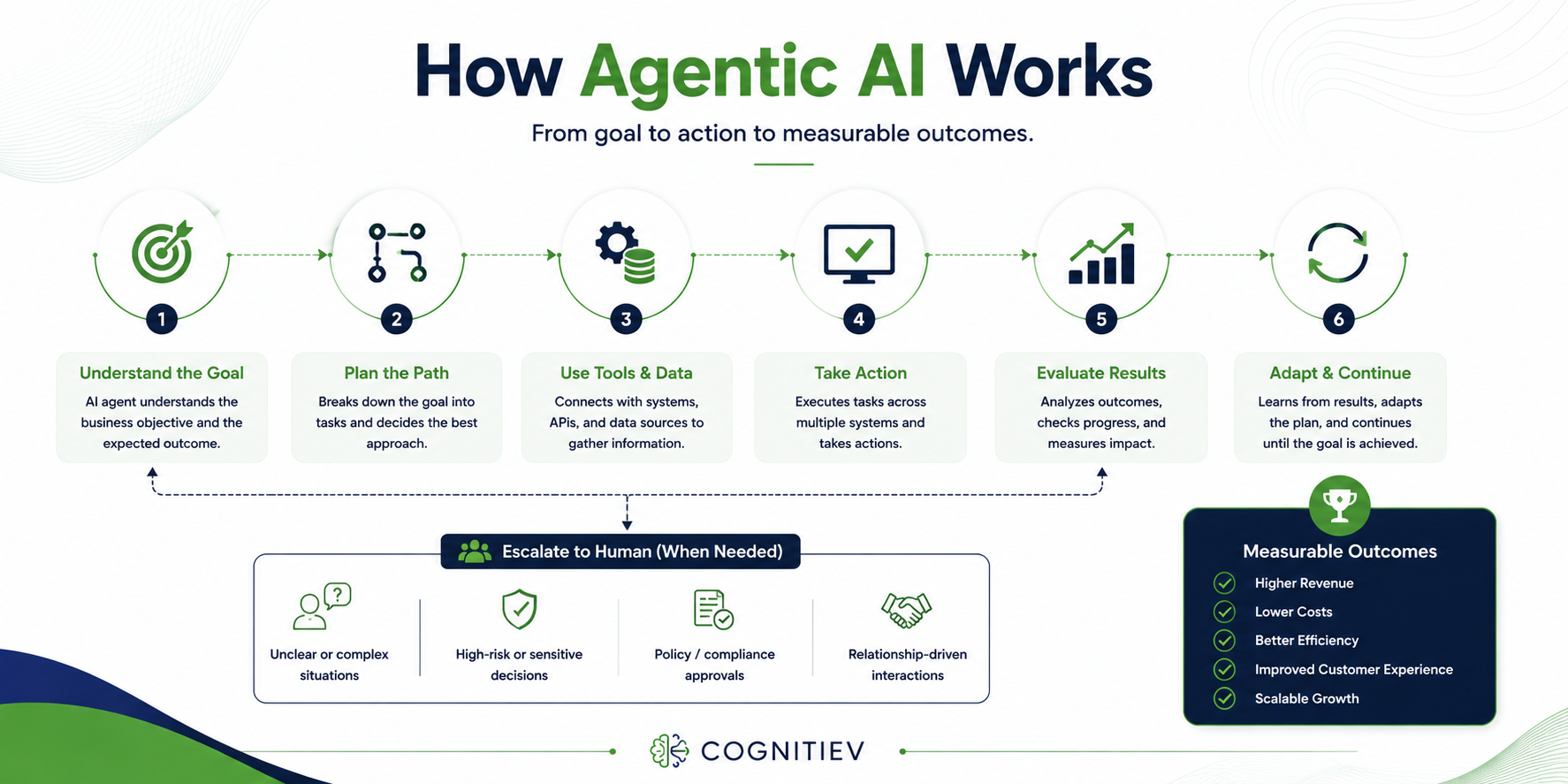
- AI model: Provides reasoning, language understanding, classification, planning, and decision-making.
- Memory and context: Supplies customer history, CRM records, product information, policies, conversations, and transaction data.
- Tools: Connect the agent to CRM APIs, calendars, email, telephony, databases, ticketing, payments, search, and internal applications.
- Orchestration: Determines which agent, workflow, or tool should execute next.
- Guardrails: Define what the agent can do, what requires approval, and when escalation is mandatory.
- Human intervention: Lets people take control when decisions are sensitive, ambiguous, expensive, or high-risk.
Agentic AI vs Generative AI
Generative AI focuses on creating or transforming information. Agentic AI focuses on achieving goals through actions. Generative AI is an important building block for many agentic systems, but the terms are not interchangeable.
| Capability | Generative AI | Agentic AI |
|---|---|---|
| Primary purpose | Generate content or information | Achieve a defined objective |
| Typical interaction | Prompt → response | Goal → plan → action |
| Decision-making | Usually user-directed | Can make bounded decisions |
| Tool use | May use tools | Core part of many systems |
| Multi-step execution | Limited or user-managed | Designed for multi-step tasks |
| External systems | Often optional | Frequently integrated |
| Adaptation | Responds to new prompts | Can adapt workflow based on results |
| Human role | Usually initiates or reviews | Can supervise or intervene |
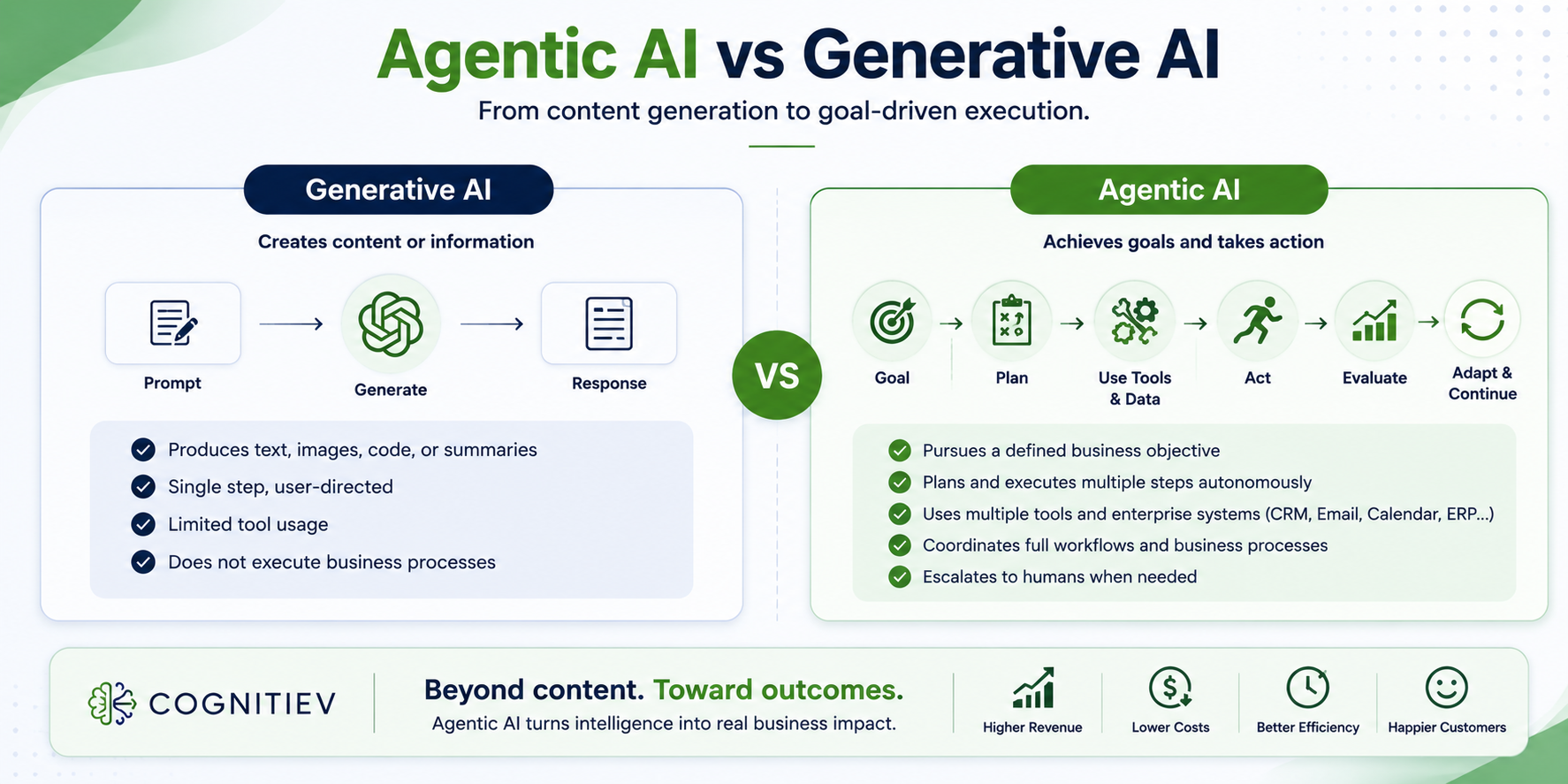
The simplest way to remember it: Generative AI creates. Agentic AI acts.
Agentic AI vs Traditional Automation
Traditional automation follows predetermined instructions: if X happens, do Y. Agentic workflows can understand a situation, determine the next step, execute, evaluate, and continue or escalate.
| Capability | Traditional Automation | Agentic AI |
|---|---|---|
| Decision model | Rule-driven | Goal-driven |
| Inputs | Predictable inputs | Can handle variable inputs |
| Workflow | Fixed workflow | Can dynamically determine next steps |
| Reasoning | Limited reasoning | Can reason within defined boundaries |
| Behavior | Usually deterministic | Probabilistic and controlled |
| Exception handling | Human handles exceptions | AI can resolve or escalate exceptions |
Enterprises may get better results by combining RPA, APIs, business rules, AI agents, and human oversight.
How AI Agents Connect to Business Processes
An AI agent should not be viewed as an isolated chatbot. It should support a real operational process and produce an outcome the organization can measure.
- Faster response time and higher conversion.
- Lower cost per interaction and reduced handling time.
- More appointments booked and fewer abandoned leads.
- Faster ticket resolution and higher employee productivity.
Agentic AI Examples for Businesses
- Sales lead qualification: Receive a lead, analyze context, qualify intent, answer approved questions, schedule a meeting, update the CRM, and escalate qualified opportunities.
- Customer support: Understand a request, retrieve account information, search the knowledge base, take an approved action, document the interaction, and escalate complex cases.
- Appointment scheduling: Manage qualification, availability checks, scheduling, confirmation, reminders, and CRM updates.
- Real estate: Identify buying intent, retrieve approved property information, score the lead, schedule a viewing, nurture the prospect, and transfer high-intent opportunities.
- Recruitment: Coordinate screening, qualification, interview scheduling, candidate communication, ATS updates, and recruiter escalation.
- Finance and operations: Assist with invoice processing, payment follow-ups, exception identification, procurement, reporting, reconciliation, and vendor communication.
- IT operations: Investigate events, retrieve logs, execute approved remediation, verify the result, and escalate unresolved incidents.
Original Cognitiev Workflow Examples
Example 1: Revenue Recovery Agent
Trigger: A lead has not responded.
- Check CRM history and review the previous conversation.
- Determine follow-up timing and contact the prospect through the approved channel.
- Understand the response, answer approved questions, and offer scheduling options.
- Update the CRM, continue nurturing when appropriate, and escalate high buying intent.
Human intervention: High-value opportunities or unusual objections.
Example 2: Omnichannel Customer Support Agent
Trigger: A customer sends a message through WhatsApp, Instagram, email, or phone.
The agent identifies the customer, consolidates context, understands intent, retrieves information, responds, performs an approved action, records the interaction, and escalates if necessary.
Example 3: Healthcare Appointment Workflow
Trigger: A patient requests an appointment.
The agent understands appointment intent, collects permitted information, checks availability, schedules and confirms the appointment, sends a reminder, updates the relevant system, and escalates requests outside its approved scope.
The Cognitiev 7-Stage Agentic AI Framework
Implementing agentic AI is a business transformation exercise, not simply the deployment of another AI tool.
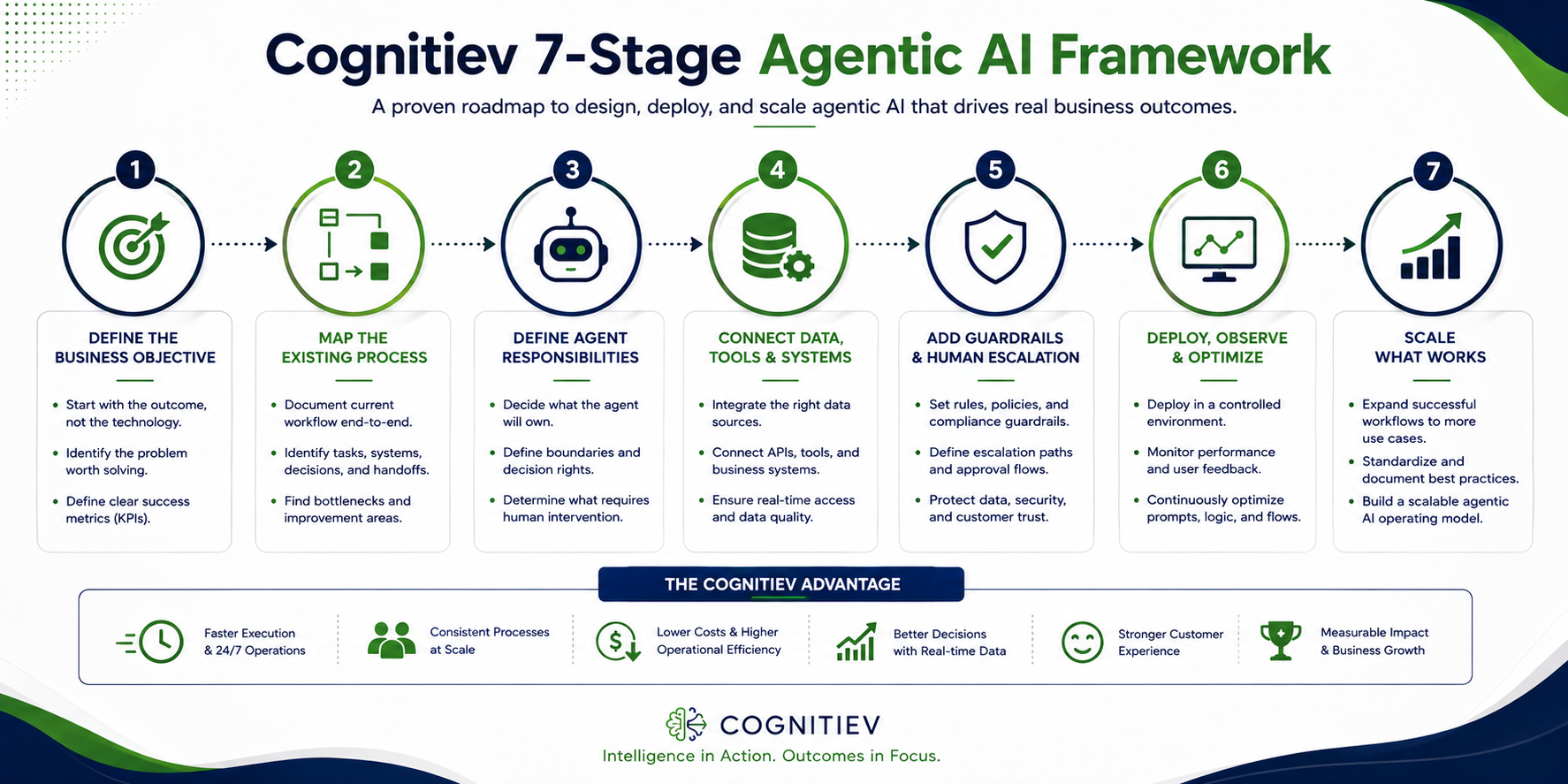
- Identify the business objective: Start with the outcome you want to improve.
- Map the existing process: Document triggers, tasks, systems, decisions, handoffs, exceptions, people, and KPIs.
- Determine agent responsibilities: Define what the agent owns and what remains with people.
- Connect data, tools, and systems: Integrate CRM, calendar, telephony, email, messaging, knowledge, ERP, and ticketing systems.
- Add guardrails and human escalation: Define permissions, approvals, data access, logging, and takeover conditions.
- Deploy, observe, and optimize: Measure completion, failure, escalation, response time, conversion, satisfaction, cost, and workload.
- Scale what works: Expand reliable workflows into follow-up, scheduling, onboarding, support, and retention.
What Are the Benefits of Agentic AI?
Agentic AI can help organizations execute work faster, at greater scale, and with better coordination across systems.
Faster Execution
Agents can operate continuously and respond quickly to events. This is particularly valuable when response speed affects revenue or customer experience.
Greater Scalability
A digital agent can potentially handle many interactions without increasing workload linearly. Cognitiev positions its AI calling and automation infrastructure for high-volume communication and automated follow-up.
Reduced Repetitive Work
Agents can handle repetitive coordination, data entry, follow-up, scheduling, and routine communication. Employees can then spend more time on judgment, creativity, negotiation, and relationship building.
Consistent Process Execution
A properly designed agent can apply the same workflow rules across large volumes of interactions.
Better Cross-System Coordination
Instead of employees manually moving information between applications, agents can connect multiple systems through APIs and workflow orchestration.
24/7 Operations
Agents can continue working outside traditional business hours. This can be valuable for companies serving customers across multiple time zones.
What Are the Risks of Agentic AI?
Agentic AI also introduces risks that leaders should take seriously.
Incorrect Decisions
An agent can misunderstand information or make an incorrect decision.
Excessive Autonomy
Giving an AI unrestricted access to sensitive systems can create unnecessary operational risk.
Data Security
Agents may interact with sensitive customer or company information, making access control essential.
Prompt Injection and Manipulation
Agents connected to external data and tools can face security threats that traditional chatbots may not encounter in the same way.
Compliance
Industries such as healthcare, finance, insurance, and legal services require strong governance.
Poor Process Design
Automating a broken process can make the problem faster, not better.
Agent Sprawl
As organizations deploy more agents, managing their permissions, objectives, tools, and interactions becomes increasingly complex.
Deloitte warns that widespread agent deployment can create duplication, inconsistent governance, cybersecurity concerns, and coordination challenges without an appropriate enterprise management model.
How Business Leaders Should Approach Agentic AI
The biggest mistake is treating agentic AI as a technology procurement project. Instead, treat it as an operating-model transformation.
Ask five questions:
- What process is expensive or slow?Find a measurable operational bottleneck.
- Is the process repetitive but variable?Agentic AI is especially useful where traditional rules struggle with changing inputs.
- What decisions can safely be automated?Separate low-risk decisions from high-risk decisions.
- Where should humans remain involved?Human intervention can be an intentional part of a strong agentic design.
- What KPI will prove success?Choose the metric before deployment.
Example success measures
- Average lead response: 4 hours → less than 1 minute
- Follow-up coverage: 60% → 95%
Is Agentic AI Going to Replace Employees?
Agentic AI is better understood as a way to redistribute work between software and people. AI can handle repetitive communication, information retrieval, classification, scheduling, follow-up, data entry, routine decisions, and workflow coordination.
Humans remain valuable for strategy, leadership, negotiation, empathy, complex judgment, relationships, accountability, and high-impact decisions.
The Future of Agentic AI in Enterprise Operations
Enterprises are moving from AI assistants to AI agents, agentic workflows, multi-agent processes, agentic business functions, and eventually more connected agentic operating models.
The opportunity is not deploying hundreds of agents. It is creating a controlled ecosystem with clear responsibilities, appropriate permissions, measurable objectives, and effective human oversight.
Frequently Asked Questions About Agentic AI
What is agentic AI in simple terms?
Agentic AI is AI that can work toward a goal by planning tasks, making bounded decisions, using tools, taking actions, and adapting its workflow with limited human supervision.
What is the difference between agentic AI and generative AI?
Generative AI primarily creates content. Agentic AI uses AI capabilities to pursue goals, coordinate steps, interact with tools, and execute actions.
What are examples of agentic AI?
Examples include agents that qualify sales leads, schedule appointments, manage customer support, screen candidates, investigate IT incidents, and coordinate business processes.
Does agentic AI require human intervention?
Enterprise systems should have defined human escalation points. The level of involvement depends on process risk, complexity, and business impact.
Is agentic AI safe for enterprises?
It can be deployed safely with appropriate permissions, security controls, monitoring, testing, governance, and human oversight.
How do I implement agentic AI?
Start with a measurable objective, map the process, define agent responsibilities, connect systems, establish guardrails, monitor results, and scale successful workflows.
Final Takeaway: Agentic AI Is About Outcomes, Not Just Intelligence
The value is not in the agent itself. It comes from what the agent enables the business to accomplish. A successful implementation connects AI agents, workflows, business processes, human intervention, and measurable outcomes.
The right question is not “How can we add AI to our business?” It is “Which business process should become faster, smarter, more scalable, and more measurable through AI?”
For enterprises exploring this transition, Cognitiev focuses on agentic AI automation across AI calling, business process automation, CRM workflows, omnichannel communication, follow-ups, scheduling, and industry-specific workflows.